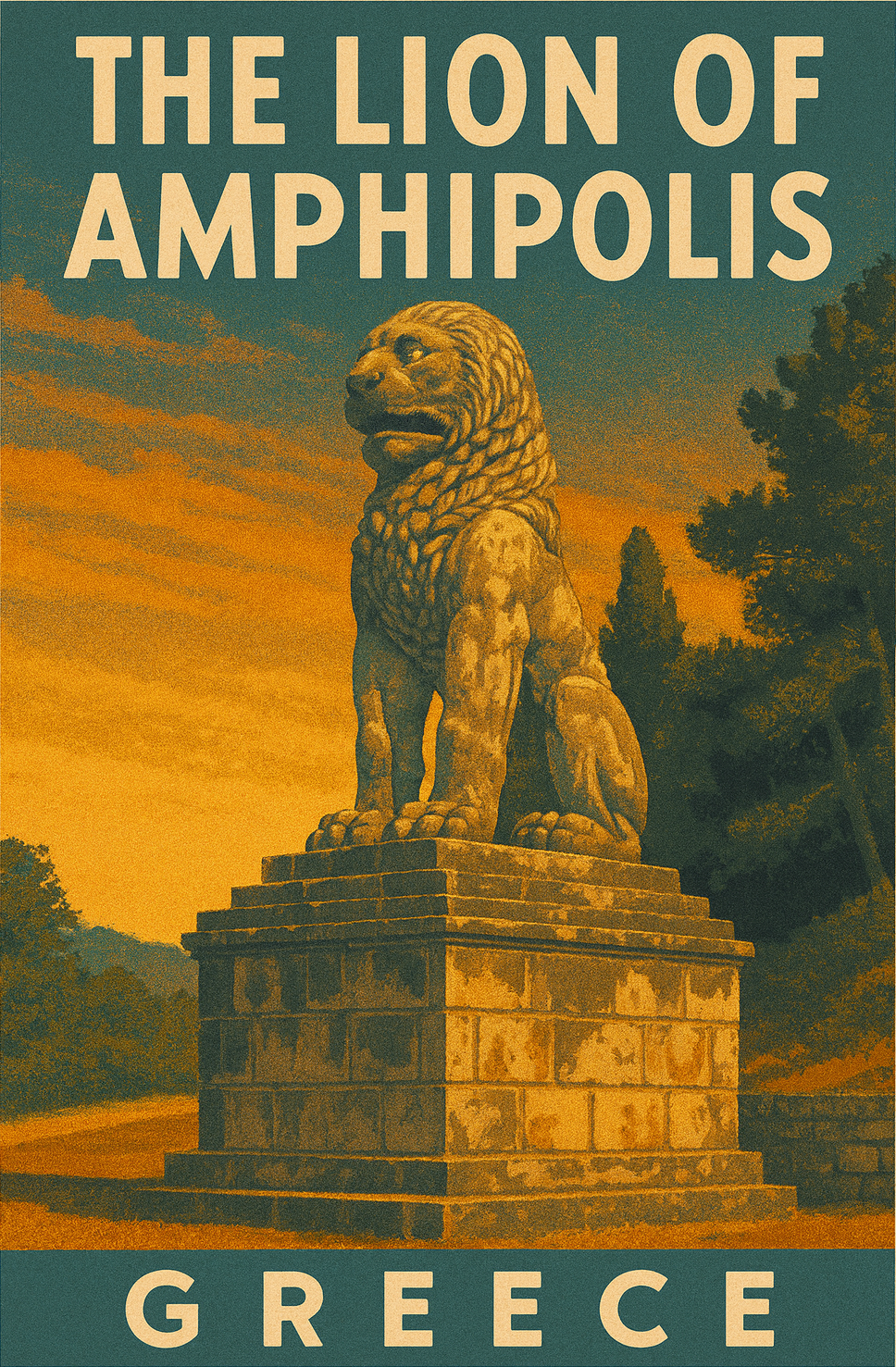
Driving home westbound on the Egnatia freeway from a full day at the beach, near Kavala, I managed to convince my exhausted family to make a small detour. Because a few minutes off the freeway lies a hidden gem of Northern Greece – The Lion of Amphipolis – a colossal marble lion rising from the fields by the Strymon River.
I’d seen this lion before — but my memory of it is mostly based on an old family photo from 1976, when my family visited with some friends.

In that photo, the statue looks almost modest, perched in the background behind my parents, seemingly barely taller than a person. Memory usually makes things look bigger when you’re a child and smaller when you return as an adult. But here it was the opposite. The lion was enormous — over eight meters high with its base, its paws as big as my chest.

The lion’s history is shrouded in mystery. We don’t know for sure what it was for, or why it was created. Scholars have several theories, but none seems to prevail.
What we do know is that the lion was carved from marble in the late 4th century BC, sometime after the death of Alexander the Great. It was part of a grand funerary monument — possibly even standing atop the massive Kasta Tomb nearby.
The first pieces surfaced in 1913, during drainage works on the nearby Strymon River. At first, only fragments of the base appeared, but over the following years more and more pieces of the lion were uncovered. Large-scale excavation got underway in the 1930s, eventually yielding over 500 fragments. The Greek sculptor Andreas Panagiotakes was then tasked with the enormous puzzle of putting the masterpiece back together. Using different techniques and comparing it with similar sculptures, he managed to reassemble the lion. By 1937, the monument stood once again — erected near its discovery site, facing the lost city of Amphipolis, on a new pedestal similar to the original. And that is the lion we see today.

What struck me most, though, was not just the size but the setting. There’s no ticket booth, no crowd, no selfie sticks. In fact it seems located in the middle of nowhere, by a small countryside crossroads, where you might otherwise expect to find a cantina truck or a desolate gas station.
A few kilometers from the lion (follow signs to “Ancient Amphipolis”), you’ll find the archaeological site and a small museum in the village of Amfipoli. The museum (reportadly, I’ve never visited myself) houses fascinating artifacts from the area – statues, grave stelae, gold wreaths, and mosaics – providing context to Amphipolis’s importance from classical to Byzantine times. Unfortunately the museum didn’t fit our schedule this day, so maybe next time. At least I’ll have a reason to come back. Let’s just hope that it doesn’t take another 49 years until the next visit.

Most travelers speed past on the Egnatia highway between Thessaloniki and Kavala, unaware that one of Macedonia’s greatest monuments is just a few minutes away. But if you pull off, you’ll find yourself standing before a reminder that history isn’t always locked up in museums. Sometimes it’s right there in the countryside, waiting quietly until you stumble upon it again — whether after two thousand years, or after a childhood photograph.

Leave a Reply