It wasn’t until a coworker from India mentioned her travel plans that I started thinking of Greece as a “milk nation.”
“I want to go to Greece and eat yogurt,” she said.
It stopped me in my tracks. I’ve heard all kinds of reasons to visit Greece—history, beaches, mythology, olives—but this was a first.
Intrigued, I asked why.
She explained that she loves to experience food when she travels, but as a as a vegetarian she’s limited, as in many places meat dominates the menu. “Milk, though—that’s something I can enjoy everywhere. And Greece? Greece is known for its dairy.”
That conversation opened my eyes. And the more I thought about it, the more it made sense.
Ye olde farmer’s milk
Growing up between Sweden and Greece, my respective experiences of milk couldn’t have been more different. In Sweden, it was a staple—cold, pasteurized, and sold in big cartons. In Greece in the 1970s, milk was something else entirely.
Back then, processed milk wasn’t widely available. If you wanted milk, it came straight from the barn, and it had to be boiled to be safe to drink.
I remember as a toddler that even at the hotel in metropolitan Athens, asking for a glass of cold milk, they didn’t have it. The best they could do was a cup of heated milk with ice cubes in it. I cried incessantly, since I found it unfathomable and cruel that people could live a life without cold milk readily available at all times.
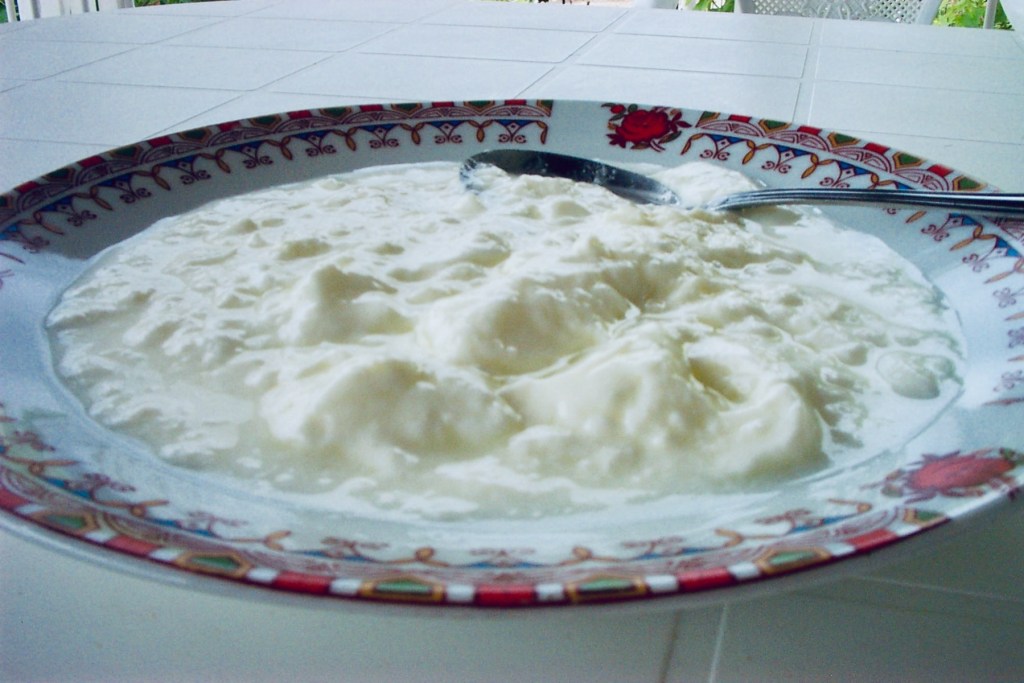
My grandfather in Greece had a daily ritual of making his own yogurt. From his morning bowl of yogurt, he’d take a spoonful and stir it into a bowl of fresh unpasteurized milk. The next morning he had a new bowl of fresh yogurt.
Greek Dairy on the World Stage
Two Greek dairy products stand out globally: feta and tzatziki. Both are widely recognized and often serve as shorthand for “Greek food” abroad.
Feta, the crumbly, tangy white cheese traditionally made from sheep’s milk (or a mix with goat’s milk), is Greece’s flagship dairy export. It holds PDO (Protected Designation of Origin) status in the EU, meaning only cheese produced in specific Greek regions using traditional methods can be sold as “feta” in Europe. Its sharp, brined character sets it apart from cow’s milk cheeses common in northern Europe.

Tzatziki, meanwhile, has a more layered history. It descends from cacık, a yogurt-based dish from the Ottoman culinary tradition, which also appears in Turkish, Persian, and Balkan cuisines in various forms. But it’s the Greek version—strained yogurt, cucumber, garlic, olive oil, and sometimes dill—that has become the internationally dominant form.
France is known for its rich, cow’s milk cheeses—Brie, Camembert, Roquefort—produced in lush pastures and aged with precision in caves and cellars.
Italy offers an equally broad dairy tradition, from hard cheeses like Parmigiano Reggiano to fresh buffalo mozzarella, shaped by regional diversity and tightly integrated into its food culture.
Switzerland leans on its alpine heritage, producing firm, nutty cheeses like Gruyère and Emmental from cows grazing high-altitude meadows—cheeses built to be stored, melted, and carried through long winters.
Eastward, in the Balkans, Turkey, and the Levant, dairy traditions are shaped by fermentation and preservation: strained yogurts, salty white cheeses, and refreshing drinks like ayran or doogh reflect a shared culinary logic across hot climates and ancient trade routes.

And then there is Greece, where the rugged, mountainous landscape favors sheep and goats, not cows. The terrain not only shaped the kind of milk available, but also made transport difficult, especially before refrigeration. There was a practical urgency to preserve milk at the source—to turn it into cheese, yogurt, or fermented drinks as quickly as possible. What began as necessity evolved into identity: a dairy tradition that favors the fresh, the brined, the tangy—not long-aged or export-driven, but deeply regional and remarkably resilient.
Feta, xinogalo, ariani, and thick strained yogurt aren’t luxury foods here. They’re daily staples, shaped by geography, history, and habit.

Common Greek Dairy Products
Sokolatenio Gala (Σοκολατένιο Γάλα) – Chocolate milk, widely available and popular with children.
Gala (Γάλα) – Milk, from cow, sheep, or goat. Sold fresh or long-life. Often given warm to children at bedtime.
Yaourti (Γιαούρτι) – Yogurt. Available plain or flavored. A daily staple.
Straggisto Yaourti (Στραγγιστό Γιαούρτι) – Strained yogurt, thicker and higher in protein. Often known outside Greece as “Greek yogurt.”
Ariani (Αριάνι) – A savory yogurt drink made with yogurt, cold water, and a pinch of salt. Served chilled, especially in northern Greece. Similar to Turkish ayran, though usually less salty. Refreshing on hot days and often enjoyed with meals
Kefir (Κεφίρ) – Fermented milk drink with probiotics. Tangy and slightly fizzy.
Xinogalo (Ξινόγαλο) – Sour milk, lightly fermented.
Galaktoboureko (Γαλακτομπούρεκο) – Semolina milk custard dessert in syrup-soaked phyllo.
Krema Galaktos (Κρέμα Γάλακτος) – Thick milk cream, used in desserts and pastries.
Evaporated Milk (Νουνού / Εβαπορέ) – Shelf-stable cow’s milk, usually unsweetened (as opposed to in the Middle East and the Balkans, where it is typically sweetened), sold in cans. Commonly added to instant coffee, especially frappé. Still a nostalgic staple in many Greek kitchens and cafés.

Carpe Dairy
Next time you’re in Greece and the scorching heat is getting the best of you, and you’re headed toward the convenience store fridge to grab a soda—try an ariani instead, or a strawberry-flavored kefir. It might just open your eyes.

Leave a Reply