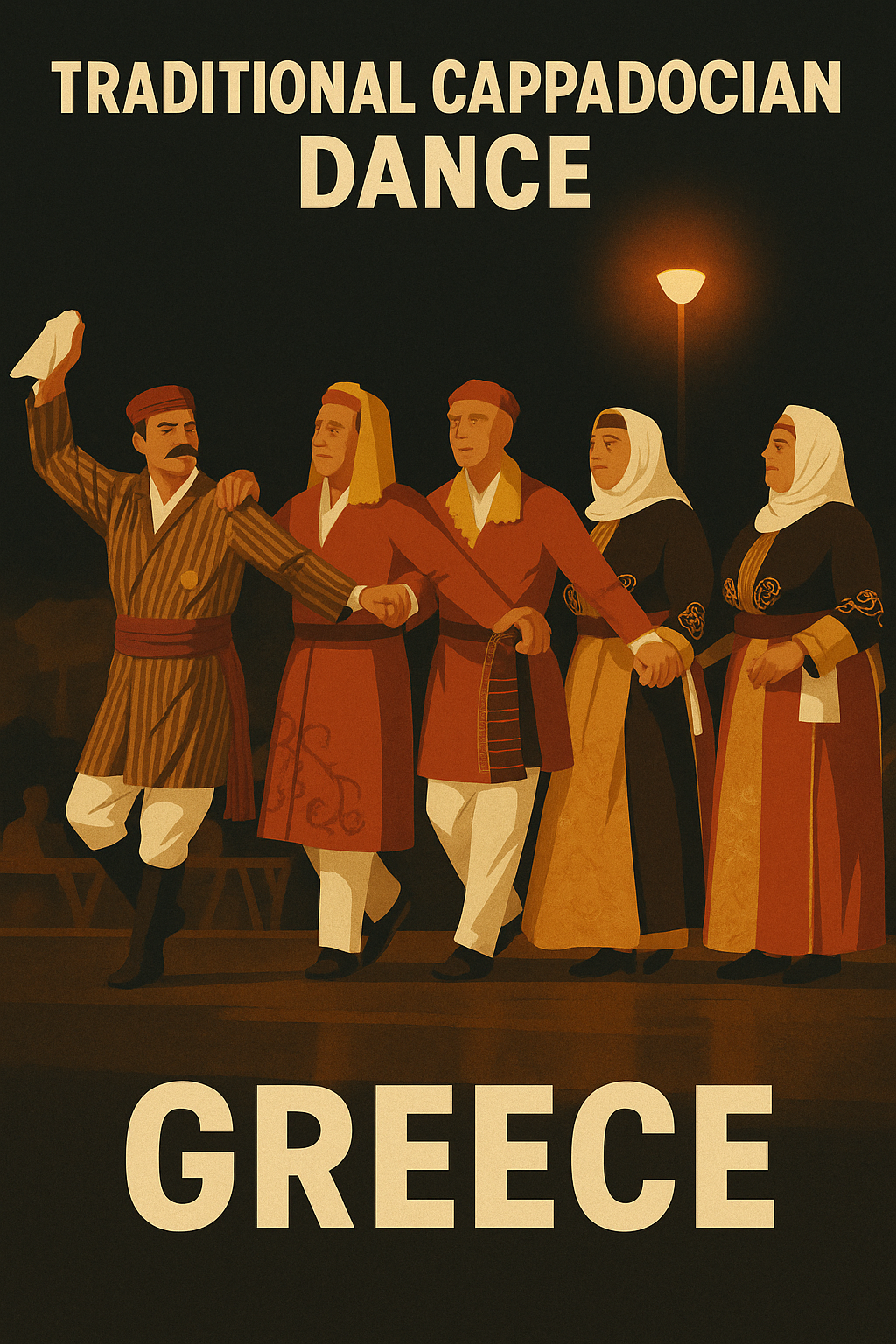
The Cappadocian Greeks were one of several Greek-speaking communities who lived for centuries in what is now central Turkey—part of a broader group known as the Asia Minor Greeks. In essence the Asia Minor Greeks stayed and kept their culture, language and religion, as the lands around them was conquered and turned in to a Muslim empire. After hundreds of years, they were forced to migrate to modern day Greece.
395 – The Roman Empire divided
The Roman Empire splits into Western and Eastern halves. The Greek-speaking Eastern Roman Empire becomes known as the Byzantine Empire, with Constantinople (modern-day Istanbul) as its capital.

1071 – The Seljuks invade
After the Battle of Manzikert, the Seljuk Turks begin taking control of central Anatolia, including parts of Cappadocia. This marks the gradual erosion of Byzantine authority in the east. The Seljuk Sultanate eventually fractured, and in its wake, the Ottoman Empire emerged as the dominant power in Anatolia.

Late 1300s–1400s – The Ottoman Empire grows
The Ottoman Empire expands across Anatolia. Cappadocia is brought under Ottoman control, ending centuries of Byzantine rule in the region.
1453 CE – Constantinople falls
In a historic battle, the Ottomans conquer the city of Constantinople, officially ending the Byzantine Empire. The city becomes the new Ottoman capital.
15th–19th centuries – Greeks as second-class citizens
Greek-speaking Orthodox Christians—including those in Cappadocia—live as dhimmi, or non-Muslim subjects, under Ottoman rule. They are allowed to keep their language, religion, and community structures, but are treated as second-class citizens, paying extra taxes and subject to various restrictions. Most live in Greek enclaves, with limited interaction with the Muslim majority.

Late 1800s–Early 1900s – Tensions rise
As nationalism rises across the Ottoman Empire, tensions increase between Christian and Muslim communities. Political instability and suspicion toward Christian minorities grow.
1919–1922 – The Greco-Turkish War
After World War I, Greece launched a military campaign into Asia Minor, encouraged by the Allies and driven by the “Great Idea”—a dream of uniting all historically Greek lands under one state. Greek forces advanced as far as Smyrna (modern İzmir) and into the Anatolian interior, including areas populated by Turks and long-established Greek communities.
What followed was a brutal and chaotic war. Turkish nationalists, led by Mustafa Kemal (later Atatürk), organized fierce resistance. The conflict culminated in the burning of Smyrna in 1922 and the retreat of Greek forces. Thousands of Greek civilians were killed or displaced in the aftermath, especially in coastal and interior regions where they had lived for centuries.

The war left deep wounds on both sides and created the political conditions that led to the population exchange a year later. It marked the definitive end of the Greek presence in Asia Minor as a continuous, rooted community.
1923 – Treaty of Lausanne and the Forced Population Exchange
In the aftermath of the Greco-Turkish War, the Treaty of Lausanne was signed between Greece and Turkey. It was meant to resolve long-standing territorial disputes and ease rising tensions between Muslims and Christians in both countries by creating more “ethnically uniform” populations. The result: one of the largest state-mandated population exchanges in modern history.
The exchange was based not on ethnicity or language, but strictly on religion. Around 1.5 million Orthodox Christians from Asia Minor (modern-day Turkey) were forced to move to Greece, while roughly 500,000 Muslims from Greece were relocated to Turkey. No exceptions were made. It didn’t matter if your family had lived on that land for centuries.

Among the displaced were several distinct groups of Greek-speaking Christians:
- Pontic Greeks (from the Black Sea region): approximately 750,000 people
- Cappadocian Greeks (from central Anatolia): around 100,000–130,000
- Ionian and Aeolian Greeks (from the Aegean coast, including Smyrna)
- And others from regions like Phrygia, Bithynia, and Eastern Thrace
Although the migration was technically supervised and sponsored by the state, the reality on the ground was brutal. Families were given little time to pack, and most had to abandon homes, land, livestock, and possessions. They left behind churches, schools, and entire village histories.
Along the way, many were forced to spend what little money they had on food, lodging, bribes, and protection. There were no guarantees of safety, and organized help often came too late. Some families even sold jewelry or heirlooms to survive the journey.
By the time they reached Greece, most had nothing. And the welcome wasn’t warm. Seen as outsiders, these refugees—often called “Turkish Greeks” or “foreigners” in their own ancestral homeland—were treated as second-class citizens. They spoke different dialects, had Anatolian customs, and were sometimes resented by the local Greek population for burdening an already fragile post-war economy.

The exchange may have achieved political “stability,” but it did so by tearing apart communities and erasing centuries of cultural life. For the Cappadocian Greeks, it was not just a relocation. It was an exile.
1923–1940s – Displacement and poverty in northern Greece
After arriving in Greece, most Asia Minor refugees were resettled in the northern regions—Macedonia, Thrace, and parts of Thessaly—where land and homes had been left behind by Muslims who were sent to Turkey in the same exchange. Some families were assigned abandoned property, but many had to start from nothing. The villages they were sent to were often remote, underdeveloped, and already struggling to survive.
What followed was the beginning of a difficult cycle. Refugee families worked as laborers, tenant farmers, or in unstable seasonal jobs. They were often seen as outsiders, even by other Greeks, because of their Anatolian customs, dialects, and food. Their Orthodox faith wasn’t enough to fully bridge the gap. They were different—and they were poor.
1950s–1960s – Migration abroad
By the 1950s and 60s, Greece was still recovering from war and economic hardship. For many families descended from Asia Minor Greeks, the only option was to leave again—this time to northern Europe, North America, or Australia. It wasn’t an easy decision, but it was a familiar story: packing up, starting over, chasing a future somewhere else.

They went to Germany, Sweden, and the Netherlands to work in factories and construction. Others headed for the United States, Canada, and Australia, opening small businesses or taking up work wherever they could. These migrants often sent money back home, supporting entire villages with their earnings abroad.
Present day – Remnants of a fading culture
Today, when you meet someone in the Greek diaspora, there’s a good chance they’re descended from Asia Minor Greeks. The story of Cappadocian and Pontic families didn’t end with the 1923 exchange; it simply shifted, spreading across continents while still rooted in that shared history of loss, resilience, and migration.
Among them, the Cappadocian Greeks hold a special place. Their culture—marked by unique dialects, music, dance, cuisine, and religious traditions—has become something of a niche passion for historians, linguists, and descendants alike.

Even though the communities were dispersed nearly a century ago, clubs, associations, and cultural festivals continue to celebrate and preserve what remains. From folk dances to old recipes, and even rare recordings of the Cappadocian Greek dialect, these efforts keep the memory of a lost homeland alive.

In recent years, some descendants have even made emotional journeys back to their ancestral villages in Turkey—walking the same paths their grandparents once fled—paths they were never allowed to return to.
Leave a Reply